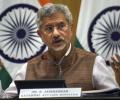
Jaishankar, speaking at a virtual event hosted by the Asia Society, said that India has built the relationship with China over the course of last 30 years "and a basis for building that relationship has been peace and tranquillity along the Line of Actual Control".

'The border stand-off and the uncertainties that come with it should be a wake-up call on what makes for real rather than illusory power,' observes T N Ninan.

'Our defence services are in a position to checkmate any Chinese adventurism.'

Former champions Kolkata Knight Riders will look to strike a perfect balance under the astute leadership of Eoin Morgan when they open their IPL campaign against a consistent Sunrisers Hyderabad in Chennai on Sunday.

Trump can afford to say that COVID-19 is a 'China virus', but we can't expect Modi to say that aloud while his actions may speak louder, says Rup Narayan Das.

'The Chinese thought India would back off. 'They did not expect such a firm Indian response to their expansionist manoeuvre.'
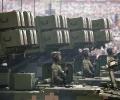
The first priority for the new Tibetan administration in Dharamsala should be to look at Tibetan recruitment in the PLA, suggests Claude Arpi.

The ministry of home affairs on Tuesday clarified India's stand of giving Asylum to Myanmar refugees, saying that the country is not a signatory to the 1951 UN Convention relating to the Status of Refugees and the 1967 Protocol thereon.

'We are facing the most critical military situation with China in the last 50 years.'

Future conflict will involve bypassing of frontiers to strike at critical vulnerabilities directly and in the hinterland at the appropriate time, explains Lieutenant General Anil Chait (retd), who served as chief of the Integrated Defence Staff and Central Army Commander.
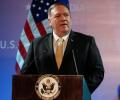
Pompeo, during a Congressional hearing on Thursday, told the members of the House Foreign Affairs Committee that 'the actions are entirely consistent with what they have been signalling to the world for decades you might even argue since 1989, but certainly since General Secretary Xi came to power'.

'It is nobody's contention that uncomfortable questions regarding national security should not be raised. But that is a topic for another day and another time when the immediate threat has faded,' argues Vivek Gumaste.
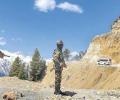
'India is not going to accept whatever the Chinese say. That is not going to happen.'
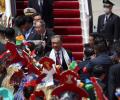
Wang Yang and Xi Jinping's visits signal the beginning of a major Chinese push to bring about a transformation of Tibet, observes Jayadeva Ranade, the distinguished China expert and retired RA&W officer.
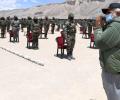
The opposition party also launched a scathing attack on Prime Minister Narendra Modi and asked why is he "so kind" to Chinese President Xi Jinping and "not showing loyalty towards the country".

Some of the best moments from PM Modi's China visit.

'Unlike the Chinese army that has been largely a peace time force, the Indian Army is a battle hardened force,' explains Colonel Anil A Athale (retd).

Prime Minister Modi made a strategic blunder of Nehruvian proportions -- presuming no war can happen now, and the Chinese won't be a military threat and risk their economic interests, observes Shekhar Gupta.
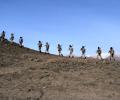
Instead of "the dragon and the elephant compete with each other", "the dragon and the elephant dance together, Chinese Foreign Minister Wang Yi said.

'India enjoys the maneuverability of a coming big power.' 'It is this possibility that has persuaded Moscow to humour India and stayed Washington from getting punitive about India's neutrality on the Ukraine issue.'

Virtually out of the play-off race, bottom-placed Sunrisers Hyderabad will hope to keep their new-found momentum intact when they face table toppers Chennai Super Kings in the IPL, in Sharjah, on Thursday.
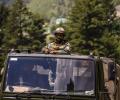
'Our biggest advantage is that the troops are much better trained and motivated than the Chinese and can improvise and manage with a part of the resources.'

'India has to ensure its borders are properly sealed and there is no infiltration from PoK.

Notwithstanding how the current impasse is solved, at some point in the future, Russia will realise that just as centuries ago it developed the paradigm of securing its heartland's safety through annexing vast buffer zones between itself and the enemy, a more modern security is possible only through friendly relations and sustainable peace, observes Shyam G Menon.
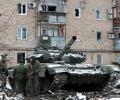
The fault line between the West and Russia has widened into a deep chasm and this is likely to endure in the foreseeable future. Far from forcing its way into the European tent, Russia may be reduced to the status of an even more sullen and weakened bystander on its periphery. The US appears to have won this hand with little cost to itself, observes former foreign secretary Shyam Saran.
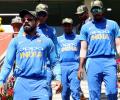
As a mark of respect for the Central Reserve Police Force (CRPF) personnel who lost their lives in the Pulwama terrorist attack, the Indian team sported special Army caps during the third ODI against Australia in Ranchi on Friday.
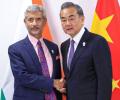
The joint statement said Jaishankar and Wang agreed that both sides should take guidance from the series of consensus reached between leaders of the two countries on developing India-China relations, including not allowing differences to become disputes.

'The military officers at China's National People's Congress reflect Xi Jinping's preference for elevating politically reliable, younger, officers with good professional qualifications,' says former RAW officer and China expert Jayadeva Ranade.
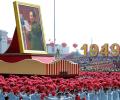
'The leadership is confronted with an economy growing at its slowest pace in 20 years,' points out Claude Smadja.

'These tactics are particularly evident in China's pursuit of its territorial and maritime claims in the South and East China Seas as well as along its border with India and Bhutan'

The step has been taken to boost tourism in Ladakh and give people a window to appreciate the tough work done by Army jawans and engineers in extreme weather and inhospitable terrains, he said.
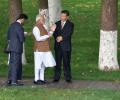
'The meeting marks the first tentative step in the effort to understand whether the two largest Asian nations can co-exist peacefully while realising their aspirations.' 'Caution and watchful wariness will dominate the effort of both sides,' says Jayadeva Ranade, former RA&W officer and China expert.
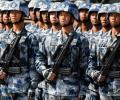
'This is the first time that active PLA army personnel would be reduced to below one million,' PLA Daily said.

The Ministry of External Affairs said the two ministers discussed the outstanding issues related to disengagement from all friction points along the Line of Actual Control in eastern Ladakh.

Statesmanship requires that the prime minister himself reaches out to those amassed at the Singhu and Ghazipur borders. Modi should be able to win over this domestic front with sheer compassion, observes Virendra Kapoor.

A new book reproduces original Chinese maps that contradict Chinese propaganda. The book reveals Chinese intelligence admissions that Beijing never maintained any army base, customs office or other government function in the disputed area until 1983.

Chinese Consul General Ma Zhanwu also asserted that by working together cooperation and exchanges can be further enhanced.
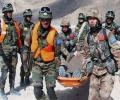
'For the moment in Eastern Ladakh, it is unlikely there will be any more escalation of this conflict,' observes Colonel S Dinny (retd) who served as Commanding Officer of an infantry battalion deployed in the Pangong Tso area.
The magazine in its cover story, titled 'Revisiting Tiananmen Square', has said globally the anti-China sentiment is at its peak since 1989 students' protests. The publication has made this claim citing an assessment report of the China Institute of Contemporary International Relations (CICIR), a think tank affiliated to the Ministry of State Security, which happens to be China's top intelligence body.

What was the need for Xi Jinping, general secretary of the Chinese Communist Party, President of the People's Republic of China and Chairman, Central Military Commission, to don the new role of Commander in-Chief? Does this mean that the most powerful Chinese leader since Mao faces numerous threats from within the Communist Party?
 © 2026 Rediff.com - Investor Information - Advertise with us - Disclaimer - Privacy Policy - Sitemap - Feedback - About us - Terms of use - Grievances